
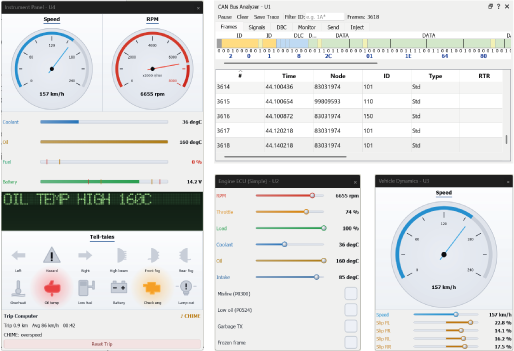
- A full vehicle network of behavioural ECUs on a single bus.
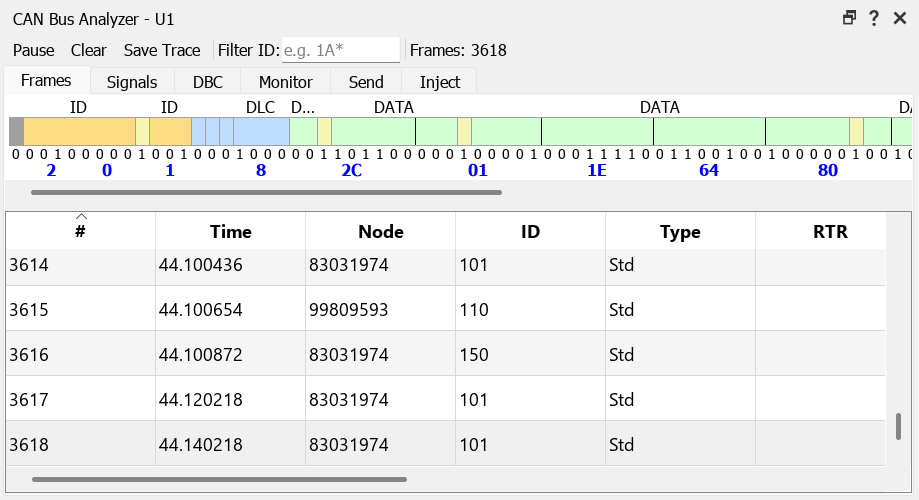
- The CAN Bus Analyser decodes every frame by name.
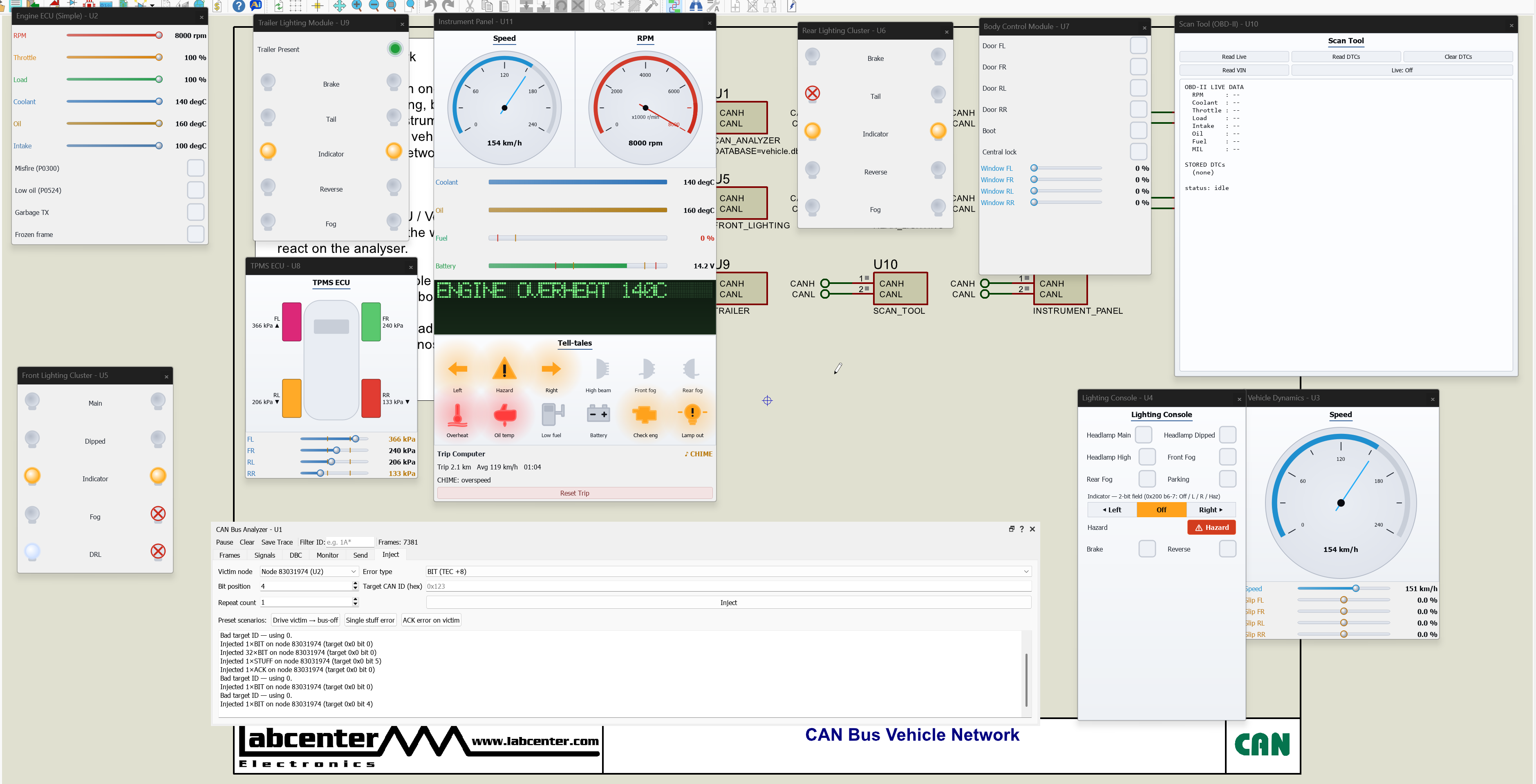
- Inject faults safely and diagnose them on the bus.
Overview
Automotive CAN in Proteus is a system-level simulation of a car's in-vehicle network. A set of behavioural car-part models, an engine ECU, a dashboard, lighting, braking, tyres and more, all talk to one another over a CAN bus drawn on the schematic. Your own microcontroller joins the same bus and runs real firmware alongside them. Because the car parts are behavioural models rather than full processors, a whole network simulates at about the cost of a single microcontroller and keeps running responsively while you work.
Download the Can Bus Simulation Flyer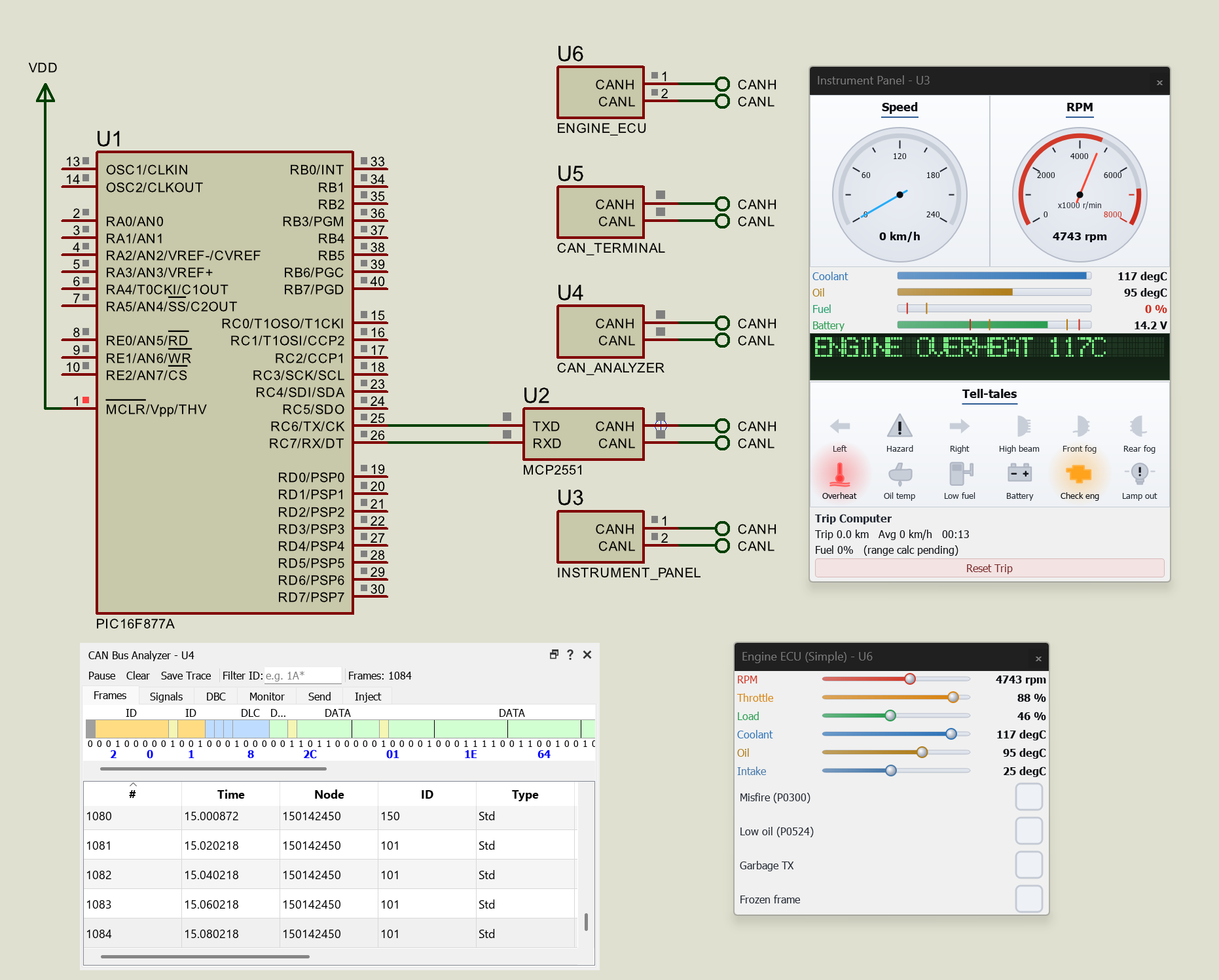
Works With Any Proteus VSM Processor
Some devices have a CAN controller built in. A pyboard or an STM32F103, for example, put frames straight onto the bus. Most microcontrollers do not, but that's not a problem: any Proteus VSM processor, a PIC, AVR, 8051, Arduino or ARM, can take part by talking over SPI to a stand-alone controller model. Proteus supplies the MCP2515 for classical CAN and the MCP2518FD for CAN FD, which build and receive the CAN frames on the microcontroller's behalf.
Between the controller and the wire sits a CAN transceiver, such as the MCP2551, which turns the logic-level transmit and receive lines into the differential CANH and CANL pair the bus actually carries. Every behavioural car-part model simply connects to that same CANH and CANL pair, and so does the CAN Bus Analyser, which is how you measure and analyse the traffic while the simulation runs.
CAN simulation is included with every Proteus VSM family. Choose the processor family your course or your team already uses, and teach or train automotive CAN with it.
What You Can Teach With It
Watch VideoTeaching CAN in software changes what you can put in front of a class. You are not held back by a bench of fragile hardware, so every student sees a properly busy network, breaks it in ways that would be impractical on real ECUs, and runs the identical exercise at home. The whole system is visible, repeatable and safe.
Behavioural Car-Part Models
Watch VideoEach car part on the bus is a single schematic component with two CAN pins and a live popup, where gauges sweep, lamps light and sliders inject stimulus. They model the behaviour a real ECU shows on the wire, the messages it sends, the messages it acts on and how it fails, right down to the specific trouble code a real ECU would raise, without simulating the processor inside it. That is what lets a whole vehicle network run at the cost of one microcontroller. Drop them onto the bus around your student's MCU to give it a realistic network to talk to.
CAN Bus Analyser
The CAN Bus Analyser is the window onto the bus. It captures and timestamps every frame, decodes it by name from the loaded DBC file, and opens any frame field by field, from its identifier and data through to the CRC. Load the matching database and the traffic reads as named messages in engineering units rather than raw hex.
It is an active node as well as a monitor. It transmits frames on demand, so you can stimulate the bus with no firmware at all, reports each node's error state, and injects faults to drive a node into bus-off. Trace files export in the industry-standard Vector and PEAK formats.
For teaching it is the single surface where cause and effect meet: change a timing constant, inject a fault or mount an attack, and watch the result on the same window the class is already reading.
A Complete Course, Ready to Teach
There is a complete In-Vehicle Networking course available on purchase, built on this simulation. It runs from the first frame to a whole-vehicle capstone across more than forty sessions, and every session ships as a complete pack so you are not writing it from scratch.